Home > News > Industry news > Wideband vs Narrowband Drone Jammer Modules
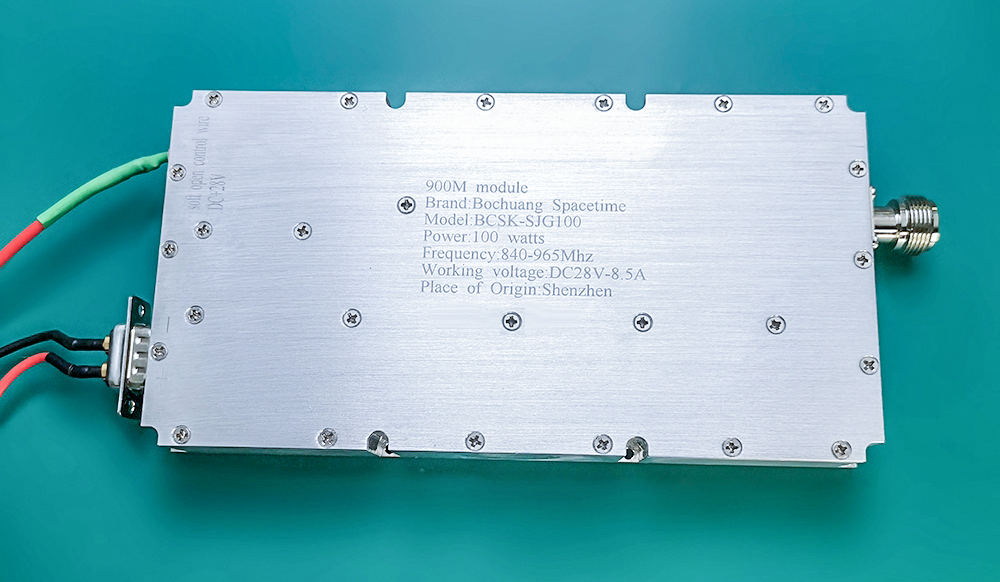
When selecting a drone jammer module for counter‑UAS applications, one of the most fundamental decisions is whether to use a wideband or narrowband design. Both approaches have their own engineering trade‑offs, operational strengths, and limitations.
This article compares wideband and narrowband drone jammer modules across key parameters: frequency coverage, jamming effectiveness, power efficiency, risk of collateral interference, and typical deployment scenarios. By the end, you’ll know which technology fits your specific anti‑drone mission.
A wideband (or broadband) jammer emits radio frequency energy across a large continuous portion of the spectrum. Instead of targeting a single, precise frequency, it “blankets” an entire band – for example, the whole 2.4 GHz ISM band (2.400–2.4835 GHz) or a wide slice of the 5.8 GHz band.
Typical wideband jamming approach:
One amplifier + one antenna covering the whole band of interest
Often used in portable or low‑cost jammers
Simpler hardware design but less efficient
| Advantage | Explanation |
|---|---|
| Simple design | Fewer components, easier to manufacture |
| No frequency tuning needed | Jams all channels within the band automatically |
| Effective against frequency‑hopping drones | Drones that hop between dozens of channels still get disrupted |
| Lower cost (often) | Single RF chain reduces BOM cost |
| Disadvantage | Explanation |
|---|---|
| High power waste | Spreads energy over many unused frequencies |
| Short effective range for given power | Energy per Hertz is low → less “punch” at the drone receiver |
| High risk of collateral interference | Can disrupt Wi‑Fi, Bluetooth, and other legitimate devices over a large area |
| Poor spectral compliance | Often exceeds regulatory emission masks |
A narrowband jammer concentrates all its output power into a very small frequency segment – sometimes as narrow as a single communication channel (e.g., 1–5 MHz). It precisely targets the specific frequencies used by the drone’s control link, video downlink, or GPS signal.
Typical narrowband jamming approach:
Digitally controlled synthesizer + narrowband power amplifier
Often software‑defined radio (SDR) based
Requires knowledge of the target drone’s frequency plan
| Advantage | Explanation |
|---|---|
| High power density | All output power focused on a small slice → much stronger signal at the drone’s receiver |
| Longer effective range | For the same total power, narrowband jamming achieves 2–4× the range of wideband |
| Minimal collateral interference | Only affects the specific frequencies being jammed; nearby Wi‑Fi or radio services may remain unaffected |
| Better regulatory compliance | Easier to stay within allowed emission masks and power spectral density limits |
| Stealthier | Less detectable by spectrum monitoring systems |
| Disadvantage | Explanation |
|---|---|
| Requires frequency agility | Must know which frequency the drone is using; needs fast scanning or detection to keep up with frequency hopping |
| More complex hardware | Typically requires SDR, fast synthesizers, and adaptive algorithms |
| Higher cost | Additional processing and multiple narrowband chains increase price |
| Not plug‑and‑play | Needs integration with a detection subsystem to identify the active frequency |
| Parameter | Wideband Jammer | Narrowband Jammer |
|---|---|---|
| Power efficiency | Low (power spread thin) | High (power concentrated) |
| Effective range (same output power) | Short | Long (3–4× further) |
| Collateral interference | High risk | Low risk |
| Ability to jam frequency hopping | Good (blankets entire band) | Requires fast following or multi‑tone jamming |
| Hardware complexity | Low | Medium to high |
| Cost | Low to medium | Medium to high |
| Regulatory compliance | Difficult | Easier |
| Typical application | Close‑range, low‑cost portable jammers | Long‑range, precision, fixed or vehicle‑mounted systems |
Consider two jammers – one wideband, one narrowband – each with 10W total output power targeting a drone at 500 meters using the 2.4 GHz band.
Wideband (80 MHz bandwidth) – Power spectral density: 10W / 80MHz = 0.125 mW/MHz.
The drone’s receiver (typically 1–2 MHz bandwidth) only sees ~0.125–0.25 mW of jamming power.
→ Limited effective range, easily overcome by a clean drone signal.
Narrowband (2 MHz bandwidth) – Power spectral density: 10W / 2MHz = 5 W/MHz.
The drone’s receiver sees ~5–10 mW of jamming power – 40× stronger than the wideband case.
→ The drone loses link even if its signal is relatively strong.
Result: For the same amplifier power, narrowband jamming can achieve 3–4 times the jamming range.
A common concern: “What if the drone hops across 50 channels?” A single fixed narrowband jammer would miss most hops. The solution is narrowband follow‑jamming (also called “tracking jamming”):
A detection receiver scans the band and identifies the drone’s current hopping channel.
The jammer synthesizer instantly retunes to that channel.
This repeats faster than the drone’s hop rate.
Modern SDR‑based narrowband jammers can track frequency‑hopping drones with hop rates up to several thousand hops per second. Alternatively, a multi‑narrowband jammer uses multiple parallel narrowband transmitters to cover the most commonly used channels simultaneously.
Wideband jammers avoid the tracking complexity but at the cost of massive power waste and interference.
Your required jamming range is short (<200–300 meters)
You need a very low‑cost, simple portable jammer
You are operating in an RF‑isolated environment where collateral interference is not a concern (e.g., remote test range)
The target drones use unknown or unpredictable frequencies and you have no detection capability
You need long range (>800 meters) or power‑efficient operation
Collateral interference to surrounding communications (Wi‑Fi, cellular, emergency services) is unacceptable
You have or can integrate a detection & frequency‑tracking subsystem
Regulatory compliance is mandatory (most professional and military applications)
You want to minimize the jammer’s electromagnetic footprint
Many modern anti‑drone systems use a hybrid strategy:
Detection (UAD‑ZDN01‑like radio scanner) finds the exact frequencies used by the intruding drone.
Narrowband jamming or spoofing is then deployed for precise, long‑range neutralization.
A low‑power wideband “dazzle” mode may be used as a backup for unknown frequency‑hoppers.
This approach gives the best of both worlds: low collateral impact, high range, and adaptability.
| Your Priority | Recommended Type |
|---|---|
| Maximum range per watt | Narrowband |
| Lowest cost | Wideband (short range only) |
| Minimize interference to other devices | Narrowband |
| Jam frequency‑hopping drones without tracking | Wideband (but high power needed) |
| Legal / regulatory compliance | Narrowband |
| Simple, handheld “point and shoot” | Wideband (under 10W, short range) |
| Professional fixed‑site protection | Narrowband + detection |
Wideband jammers are simple and inexpensive, but they waste power, have limited range, and cause significant collateral interference. They may still be suitable for very short‑range, low‑cost, or remote‑area applications.
Narrowband jammers are more complex and costly, but they deliver far greater range per watt, minimize unintended disruption, and meet regulatory requirements – making them the clear choice for professional, long‑range, and sensitive‑environment counter‑drone operations.
When planning your drone defense system, remember: spectral efficiency matters more than raw power. A well‑designed narrowband jammer with 20W output will often outperform a 100W wideband jammer in both range and safety.
86-13920737097
AddBuilding 2, Honggao Industrial Park, Bao’an District, Shenzhen, China.
E-mailjackyjingtj@gmail.com
Copyright @ 2026 BNT Jammer
Copyright @ 2026 BNT Jammer
Copyright @ 2026 BNT Jammer