Home > News > Industry news > Inside Drone Jammer Manufacturers: Technology Principles & Industry Applications Explained
With the rapid advancement of drone technology, the need to manage low-altitude airspace has become increasingly urgent. From safeguarding airport perimeters to securing major events, from military reconnaissance countermeasures to civilian privacy protection, drone countermeasure technology has emerged as a critical tool for ensuring airspace security. At the heart of this technological chain are drone jammer manufacturers. By developing high-precision, multi-band countermeasure devices, they provide tailored solutions for diverse scenarios, acting as the “invisible guardians” of low-altitude safety. This article delves into the technical principles behind drone jammers, their industry applications, and the core competencies of leading manufacturers, offering a comprehensive look at the innovation driving this field.
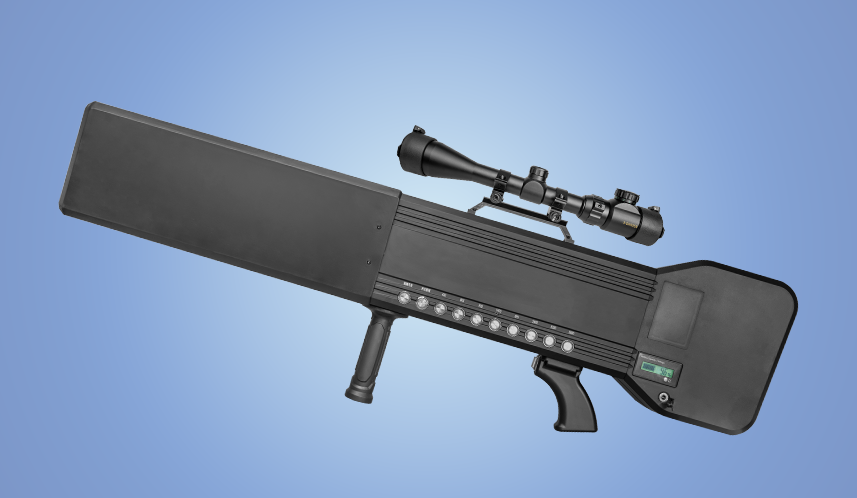
The core technology of drone jammers can be summarized into two main approaches: signal blocking and navigation jamming. The working principle is similar to “signal shielding” in radio communications but optimized for the specific frequency bands and communication protocols used by drones. When a jammer emits electromagnetic waves at targeted frequencies, it either overwhelms the communication link between the drone and its remote controller or interferes with its GPS navigation signals. This forces the drone into an uncontrolled state—hovering, returning to home, or landing—thereby achieving effective control over the target.
Drone jammers typically cover common drone communication bands such as 2.4 GHz and 5.8 GHz, as well as navigation bands like GPS L1 (1575.42 MHz) and BeiDou B1 (1561.098 MHz). Advanced devices support multi-band simultaneous jamming to counter the anti-interference designs of various drone models. For example, some manufacturers offer “tri-band jammers” that can disrupt a drone’s video transmission, control link, and navigation signals at once—even if the target uses frequency-hopping technology.
The transmit power of a jammer directly affects its effective range. Civilian-grade devices typically operate at lower power, with effective ranges between 500 meters and 2 kilometers, suitable for fixed scenarios like airports and prisons. Military-grade jammers can reach power levels of tens of watts, with ranges exceeding 5 kilometers, and can be integrated into vehicle-mounted or airborne platforms for mobile countermeasures.
Drone jammers have permeated multiple sectors, with their core value lying in preventive security control. Below are typical application scenarios:
Airport perimeters are a prime application area for drone countermeasures. Drones straying into runways or flight paths can cause catastrophic accidents. Jammer manufacturers often collaborate with airport security to deploy fixed or mobile countermeasure systems, creating a “low-altitude protective net.”
During large conferences, sports events, and gatherings, drones may be used for unauthorized filming or carrying hazardous payloads. Portable jammers allow security personnel to patrol and respond quickly to potential threats.
In military operations, drone jammers are essential for countering enemy reconnaissance UAVs. Military-grade jammers are often integrated into armored vehicles or drone defense systems, featuring high power and multi-target tracking capabilities.
As drone photography becomes widespread, privacy risks escalate. Some manufacturers now offer civilian-grade jammers for individuals and organizations to protect personal or corporate privacy.
The competitive edge of drone jammer manufacturers lies in their ability to iterate technology rapidly and adapt to diverse scenarios. Key strengths include:
Drone technology evolves continuously; newer models may employ encrypted communications or frequency hopping to evade interference. Manufacturers must constantly develop wider-band, higher-precision jammers to stay ahead.
Modern countermeasure systems are shifting from manual operation to autonomous decision-making. Leading manufacturers integrate radar detection, electro-optical tracking, and AI recognition to enable automatic detection, tracking, and jamming.
The use of jamming devices must strictly comply with radio regulations to avoid interfering with legitimate communications. Reputable manufacturers obtain certifications from authoritative bodies, ensuring their devices meet power and frequency standards.
As the low-altitude economy expands, drone countermeasure technology will evolve toward systematization, networking, and intelligence. Manufacturers will transition from “equipment suppliers” to “airspace security service providers.” For example, some companies have already launched “low-altitude security management platforms” that integrate jammers, radars, cameras, and other sensors, using big data analytics to predict drone activity and support decision-making for city administrators.
Moreover, convergence with other technologies will spawn new applications:
Integration with 5G for more precise positioning and interference.
Linking with drone detection systems to form a complete chain of detection, countermeasure, and evidence collection.
Combining with blockchain to trace the origin of illegal drones and provide forensic evidence for law enforcement.
Through continuous innovation, drone jammer manufacturers provide efficient and secure countermeasure solutions for airports, events, military operations, and civilian use. As technology advances, future jammers will become even smarter and more precise, acting as the “invisible shield” safeguarding low-altitude order. For the general public, understanding this technology not only enhances security awareness but also aids in choosing compliant and effective products.
86-13920737097
AddBuilding 2, Honggao Industrial Park, Bao’an District, Shenzhen, China.
E-mailjackyjingtj@gmail.com
Copyright @ 2026 BNT Jammer
Copyright @ 2026 BNT Jammer
Copyright @ 2026 BNT Jammer