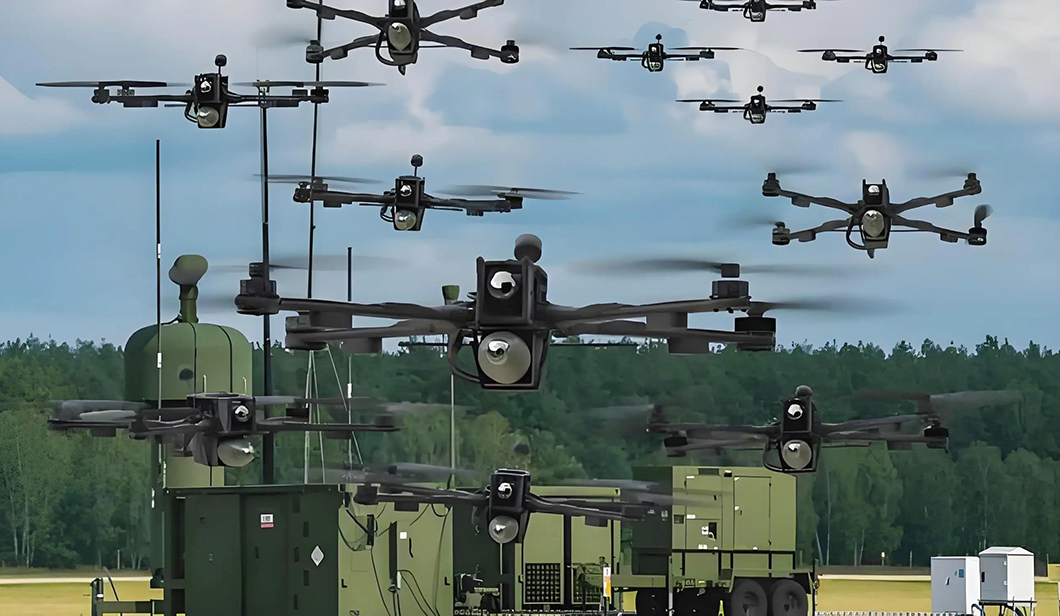
As counter-drone technology advances, security forces and military units are encountering a growing challenge: First-Person View (FPV) drones. Unlike standard commercial UAVs, which are designed with predictable communication protocols and safety features, FPV drones—often custom-built and pilot-operated—present unique obstacles for electronic jamming systems. Understanding why FPV drones are harder to jam is essential for developing effective countermeasures in modern defense.

The Nature of FPV Drone Communication
FPV drones typically operate using analog or low-latency digital video transmission systems, combined with separate RC control links. These systems often utilize frequencies that overlap with amateur radio bands (such as 5.8 GHz for video and 2.4 GHz for control), but the key differentiator is their simplicity and variability.
Unlike commercial UAVs from manufacturers like DJI or Autel—which use proprietary, often digitally encrypted communication protocols—FPV drones frequently rely on open-source or widely available transmission systems. This means that while commercial drones have predictable handshakes and frequencies, FPV drones can be configured with a vast array of components, making their electronic signature less standardized.
Why Jamming FPV Drones Is More Difficult
-
Analog Video Links Are Resilient: Many FPV drones use analog video transmission. Analog signals degrade gracefully—they don’t simply cut out like digital streams. Even under significant interference, an analog video feed may become snowy but remain partially visible, allowing the pilot to maintain situational awareness and continue the mission.
-
Frequency Agility and Customization: FPV pilots often have the ability to manually switch channels or bands mid-flight. Unlike commercial drones that might automatically hop frequencies within a limited range, FPV systems can be adapted on the fly. This unpredictability makes it harder for fixed-frequency jammers to maintain a consistent disruption.
-
Low Latency Over Robustness: FPV systems prioritize low latency for immersive flying. This often means they use simpler modulation schemes that can actually be more resistant to certain types of noise. Additionally, because the pilot is manually controlling the drone in real-time (rather than relying on autonomous GPS waypoints), merely disrupting GPS—which is highly effective against commercial drones—does little to stop an FPV attack.
-
Diversity in Hardware: Commercial drones are mass-produced with identical communication modules. FPV drones, however, are often assembled from disparate components: a video transmitter from one brand, a receiver from another, and a control link from a third. This hardware diversity means that a jamming technique effective against one FPV setup may fail against another just meters away.
-
Lack of “Fail-Safe” Reliance: Commercial drones are programmed with fail-safe behaviors: loss of signal triggers return-to-home or auto-land. FPV drones, especially those built for racing or tactical use, may have no such automation. If the control link is severed, the drone may simply continue on its last trajectory or crash—but if the mission is to deliver a payload, that may still achieve the objective.
Implications for Counter-Drone Strategy
To effectively counter FPV drones, anti-drone systems must move beyond simple GPS jamming or protocol-based disruption. Effective solutions require:
-
Wideband jamming capable of covering multiple amateur frequency bands simultaneously.
-
High power and rapid response to overwhelm analog links before pilots can adapt.
-
Integration with detection systems that identify the unique RF signatures of FPV equipment, which differ from commercial drones.
Conclusion
FPV drones represent a paradigm shift in the threat landscape. Their analog roots, pilot-dependent control, and hardware diversity make them significantly harder to jam than commercial UAVs. As FPV technology continues to proliferate—both for recreational and malicious purposes—defense systems must evolve to address these unique challenges, focusing on broad-spectrum, high-power, and adaptive jamming techniques.
Q&A
Question 1: Why does jamming GPS not stop an FPV drone?
Answer: FPV drones are typically piloted manually using video feedback, not autonomous GPS navigation. Disrupting GPS may affect their positioning, but the pilot can still fly visually, meaning the drone remains operational.
Question 2: Can wideband jammers effectively counter FPV drones?
Answer: Wideband jammers improve the chances by covering the common frequencies used for FPV video and control (e.g., 2.4 GHz, 5.8 GHz). However, because FPV systems can be manually retuned mid-flight, effective jamming often requires rapid frequency sweeping or high-power noise to overwhelm the link.