Home > News > Industry news > RF Cyber Takeover Technology: The Surgical Alternative to Destructive Counter‑Drone Mitigation
For years, radio frequency (RF) jamming has been the default counter‑drone measure. A burst of broadband noise, and the threat was supposed to drop out of the sky. But in 2026, this blunt‑force approach is facing decisive obsolescence. As drone technology advances—with fiber‑optic tethered drones, sophisticated waypoint autonomy, and encrypted communications—traditional jamming is becoming increasingly ineffective and legally risky. Relying on RF jamming for airspace security is akin to bringing a knife to a gunfight.
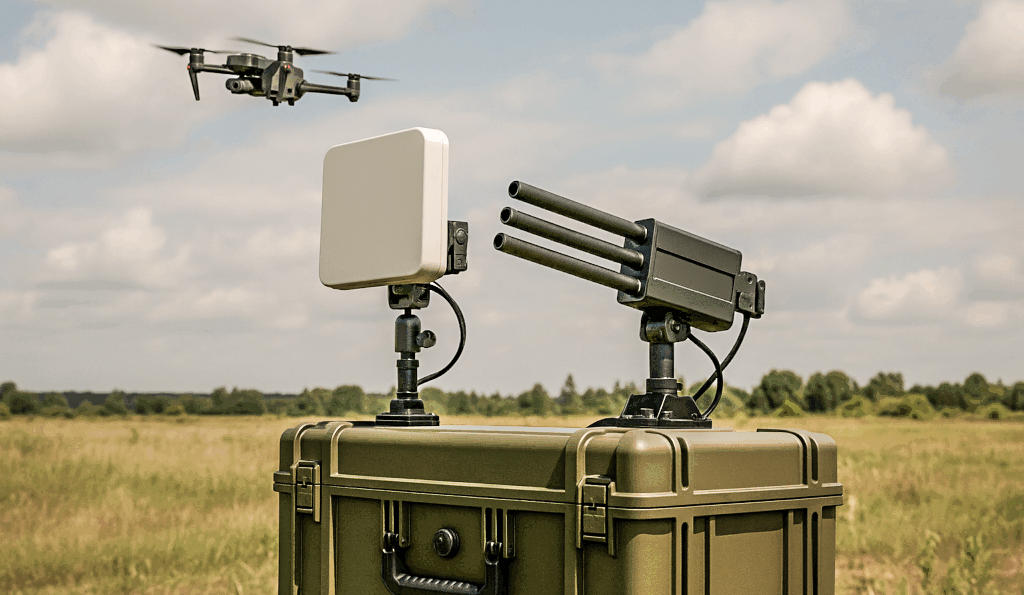
Enter RF cyber takeover: a surgical, non‑kinetic alternative that does not simply disrupt drones—it takes full control of them. This article explores how RF cyber takeover technology works, why it represents a fundamental paradigm shift in counter‑drone defense, and how it is already being deployed in real‑world scenarios.
RF cyber takeover is an advanced counter‑drone technology that uses radio frequency techniques to seize control of unauthorized or rogue drones. Unlike jamming, which indiscriminately floods the RF spectrum to disrupt communications, RF cyber takeover actively hacks into a drone‘s command and control link, overrides the operator’s commands, and redirects the drone to a safe location—all without causing collateral damage or interfering with legitimate communications.
At its core, the technology exploits vulnerabilities in drone communication protocols. Most commercial drones rely on unencrypted or weakly encrypted RF links in the 2.4 GHz or 5.8 GHz bands. RF cyber takeover systems use software‑defined radios (SDRs) and AI‑driven protocol analysis to intercept, mimic, and override these signals in real time, instructing the drone to land, hover, or return to a designated point.
The limitations of RF jamming have become glaringly apparent. Two critical advancements are rendering traditional jammers completely ineffective:
Fiber‑Optic Tethered Drones: These drones use a physical fiber‑optic cable for all command‑and‑control and data transmission, making them inherently immune to RF jamming. They also lack RF emissions, making them harder to detect with RF‑only sensors.
Waypoint Autonomy: Modern drones can operate with advanced inertial navigation systems and visual‑inertial odometry, allowing them to follow pre‑programmed waypoints even if their GPS signal is jammed. Loss‑of‑link protocols enable them to continue missions autonomously without real‑time instructions.
Moreover, jamming carries significant risks of collateral interference with legitimate communications, GPS, and critical infrastructure, and is heavily restricted or illegal for civilian use in most countries. Incidents like the Gatwick shutdown in 2018, which impacted 140,000 passengers, highlight the high cost and unintended consequences of blunt disruption methods.
RF cyber takeover systems typically operate in four stages:
Detection: RF sensors identify the drone‘s frequency and communication protocol, often supplemented by radar or optical systems for precise targeting.
Protocol Analysis: AI‑driven software analyzes the drone’s command stream in real time, reverse‑engineering the protocol if it is unencrypted. Systems like D‑Fend Solutions‘ EnforceAir use a “library‑based” approach, drawing on pre‑reverse‑engineered command sets for common drone makes and models.
Signal Override: The system transmits forged signals that override the original operator‘s commands, effectively hijacking the control link.
Safe Neutralization: Once control is seized, the drone can be redirected to a safe zone, forced to land, or disabled for physical capture and forensic analysis.
Advanced systems like EnforceAir2 offer detection distances of up to 4.5 kilometers, can distinguish between authorized and unauthorized drones in real time, and integrate seamlessly with existing security operations centers.
RF cyber takeover offers several distinct advantages over both kinetic (hard‑kill) methods and traditional RF jamming:
No Collateral Damage: Unlike shooting drones down or using nets, RF cyber takeover leaves the drone intact, eliminating debris risks and enabling forensic recovery to trace operators.
No Communication Interference: Because it targets only the rogue drone‘s specific command link, it does not disrupt surrounding communications, Wi‑Fi, GPS, or authorized drone operations.
Forensic Value: Capturing drones intact allows security teams to extract flight logs, identify takeoff points, and gather intelligence on operators—essential for counter‑smuggling and counter‑espionage operations.
Compliance‑Friendly: When properly authorized, RF cyber takeover can comply with regulations that prohibit indiscriminate jamming, making it a viable option for law enforcement and critical infrastructure protection in jurisdictions where jamming is illegal.
Operational Continuity: The technology allows authorized drones (e.g., police, media, or inspection drones) to continue operating normally while only neutralizing the rogue threat.
No technology is perfect, and RF cyber takeover has its limitations:
Library‑Dependent: It is strictly library‑based. A novel drone communicating with an unknown protocol will be immune. Drones with encrypted controller communications are also immune.
Susceptible to Protocol Changes: Manufacturers may update their protocols, requiring reverse‑engineering updates. If a manufacturer adds encryption, that drone model becomes permanently immune to library‑based takeover.
Serial Operation: Many systems control rogue drones serially—one at a time—taking seconds or sometimes minutes per drone, making them less effective against large swarms.
Fully Autonomous Drones: Drones that do not rely on any RF link (e.g., pre‑programmed autonomous missions without real‑time control) cannot be hijacked via RF takeover.
Legal Restrictions: In jurisdictions like the United States, if the system relies on communications interception and decoding, it may fall afoul of wiretapping laws unless operated by authorized agencies during special national security events.
Cost and Training: Professional RF cyber takeover systems require trained personnel and come with a high price tag. Even with autonomous modes, skilled operators are still needed to run them effectively.
The most effective counter‑drone strategies are not binary choices between jamming and takeover. Instead, industry leaders advocate for layered defense architectures that combine multiple detection and mitigation technologies.
EnforceAir PLUS, for example, integrates RF cyber takeover as its primary mitigation strategy while adding optional radar detection and RF jamming as additional layers. It also features an AI‑integrated target fusion engine that merges cyber and radar data to identify and track drones. As the president of D‑Fend Solutions noted, “Unlike purely jamming or kinetic solutions, cyber takeover enables the operator to define and execute the drone‘s behavior upon mitigation. This approach ensures continuity of airspace operations, protects bystanders, and minimizes disruption”.
The SAFERSKIES Act and similar regulatory frameworks under review in 2025 emphasize non‑kinetic solutions like RF cyber takeover for civilian sites, recognizing its role in countering agile, autonomous drones that challenge outdated defenses.
RF cyber takeover technology represents a fundamental evolution in counter‑drone defense. By shifting from blunt, destructive disruption to surgical, non‑kinetic control, it addresses the critical shortcomings of traditional jamming and kinetic methods. While not a silver bullet—encrypted drones, autonomous systems, and swarms remain challenges—RF cyber takeover is an indispensable component of modern, layered C‑UAS strategies.
For airports, critical infrastructure, public events, and border security, the ability to safely neutralize rogue drones without collateral damage or communication interference is no longer a luxury—it is a necessity. As drone threats continue to evolve, RF cyber takeover offers a precise, responsible, and effective path forward.
86-13920737097
AddBuilding 2, Honggao Industrial Park, Bao’an District, Shenzhen, China.
E-mailjackyjingtj@gmail.com
Copyright @ 2026 BNT Jammer
Copyright @ 2026 BNT Jammer
Copyright @ 2026 BNT Jammer