Home > News > Industry news > Handheld Drone Jamming Guns: Comprehensive Review of Features and Tactical Use
In the evolving landscape of counter-drone technology, few tools capture the imagination—and the headlines—quite like the handheld drone jamming gun. Resembling a futuristic rifle, these portable devices offer a uniquely flexible and immediate response to unauthorized UAV incursions. Unlike fixed-site installations that require concrete pads and power grids, a jamming gun empowers a single operator to neutralize a drone threat from the hip or shoulder. But beyond the military aesthetic, what defines a capable system? This review breaks down the critical features, performance metrics, and real-world tactical applications of modern handheld drone disruptors.
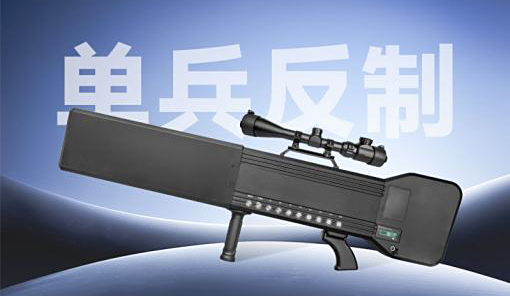
A handheld drone jamming gun is, at its core, a high-gain directional antenna array coupled with a battery-powered multi-band RF power amplifier. The operator aims the device at the target drone and pulls the trigger, which activates the internal amplifiers to transmit disruptive radio frequency energy on the specific bands used by commercial drones (typically 2.4 GHz, 5.8 GHz, and GPS L1).
The effect is line-of-sight dependent. The focused beam saturates the drone’s onboard receivers, severing its command link with the pilot and its connection to satellite navigation. The drone then executes its fail-safe protocol: either landing immediately, hovering until battery exhaustion, or returning to home.
Not all jamming guns are created equal. When reviewing specifications for procurement or operational planning, focus on these four pillars:
1. Effective Radiated Power (ERP) and Range
While manufacturers often quote raw amplifier wattage (e.g., “100W total power”), the true range is determined by Effective Radiated Power—a combination of amplifier output and antenna gain. A well-designed gun with a high-gain panel antenna may achieve a 2-kilometer effective range with only 20W per band, whereas a poorly matched system with 50W may underperform. Look for systems specifying range in real-world dBm thresholds rather than just distance in meters.
2. Band Coverage and Switching Logic
Basic jammers blast all bands simultaneously. Premium handheld guns feature selectable band triggers. This allows the operator to only disrupt 2.4 GHz and GPS while leaving the 5.8 GHz band open. This is a critical tactical safety feature; it prevents the jammer from interfering with the friendly 5.8 GHz video downlink of a security team’s own observation drone or local Wi-Fi infrastructure.
3. Ergonomics and Endurance
Tactical operations rarely last 60 seconds. Operators may need to track and hold a lock on a moving drone for several minutes.
Weight Balance: A front-heavy gun causes rapid fatigue. Premium models integrate the battery pack in the stock or as a backpack tether to balance the rifle like a standard carbine.
Battery Intelligence: Lithium-ion batteries with hot-swap capability and precise state-of-charge indicators are non-negotiable. Sudden voltage sag under load can cause the RF output to drop below the jamming-to-signal (J/S) ratio required to close the link.
4. Passive Detection Mode (RDF)
Many modern jamming guns now incorporate a Radio Direction Finder (RDF) screen. Before pulling the trigger, the operator can use the gun’s internal receiver to scan for drone signals. This screen displays the signal strength and azimuth of not only the drone but also the pilot’s remote controller. This transforms the device from a simple “jammer” into a “hunter-killer” sensor array, guiding security forces directly to the person behind the threat.
The portability of these guns dictates their specific use cases, which differ significantly from fixed infrastructure.
Mobile VIP Protection: In a motorcade moving through a dense urban canyon, a fixed jammer is useless. A handheld gun allows a security agent in the follow-up vehicle or on a rooftop to create a bubble of denial around the principal, neutralizing paparazzi drones or surveillance attempts on the move.
Rapid Response to Perimeter Breaches: Prisons and industrial sites with long fence lines cannot cover every inch with $100k radar systems. A roving patrol equipped with a handheld gun can respond to a spotter’s call of “drone sighting” in under 90 seconds, loitering in the area until the drone is forced down or flees.
Special Event Overwatch: At outdoor concerts or political rallies, the FAA may restrict blanket GPS jamming due to aviation concerns. A handheld gun offers surgical precision. The operator can engage a specific drone without blanketing the entire stadium bowl in RF noise, minimizing collateral disruption.
While powerful, these tools are not magic wands. They are reactive rather than proactive—they require visual or electronic confirmation of the target. They are also susceptible to operator error; poor aim or lack of understanding of drone fail-safe behavior (e.g., forcing a landing directly over a crowd) can create unintended hazards. Proper training in C-UAS Tactics, Techniques, and Procedures (TTPs) is just as critical as the hardware itself.
The handheld drone jamming gun fills a vital niche between the huge coverage of fixed-site systems and the zero-response capability of unarmed security. For law enforcement, executive protection, and critical infrastructure guards, these devices provide an immediate, kinetic-less option to regain control of the immediate airspace. As GaN technology continues to shrink amplifier sizes and extend battery life, the next generation of these “rifles” will only become lighter, smarter, and more integrated into the standard kit of the modern security professional.
86-13920737097
AddBuilding 2, Honggao Industrial Park, Bao’an District, Shenzhen, China.
E-mailjackyjingtj@gmail.com
Copyright @ 2026 BNT Jammer
Copyright @ 2026 BNT Jammer
Copyright @ 2026 BNT Jammer