Home > News > Company dynamics > How Drone Signal Jamming Works: RF and GNSS Explained
As drones become more accessible, the need to manage unauthorized or malicious flights has grown significantly. Whether protecting airports, stadiums, or private estates, security teams often turn to signal jamming as a primary countermeasure. But what does it actually mean to “jam” a drone? The process typically involves disrupting two critical communication links: Radio Frequency (RF) control signals and Global Navigation Satellite System (GNSS) positioning data.
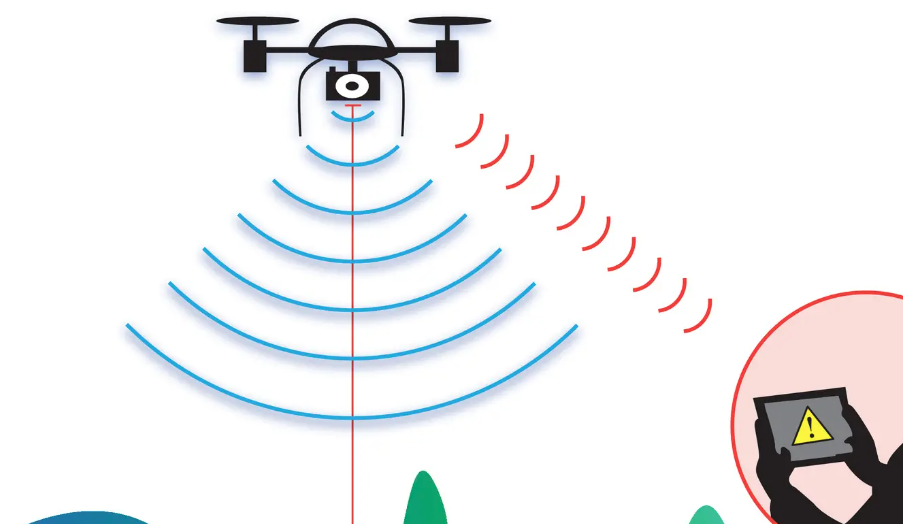
This article breaks down the technical foundations of drone signal jamming, explaining how RF and GNSS interference works, the different techniques used, and why understanding these methods is essential for modern counter-UAS strategies.
To effectively jam a drone, you must first understand the signals it depends on:
RF Control Link
Most consumer and commercial drones operate on unlicensed radio bands—primarily 2.4 GHz and 5.8 GHz. The control link transmits commands from the pilot’s transmitter to the drone, including throttle, direction, and camera functions. Disrupting this link is often the fastest way to neutralize a rogue drone.
GNSS Navigation Link
GNSS includes GPS (USA), GLONASS (Russia), Galileo (EU), and BeiDou (China). Drones use GNSS signals to maintain stable positioning, execute “Return to Home” functions, and enable autonomous flight modes. Without reliable GNSS, a drone loses spatial awareness and often reverts to a less predictable manual mode—or becomes unable to hold position.
Jamming can target either of these links independently, but professional counter-drone systems often attack both simultaneously to ensure a rapid and safe response.
RF jamming is based on a simple principle: overwhelming the receiver with noise. A jammer transmits a high-power signal on the same frequency used by the drone and its controller. When the jammer’s signal strength is sufficiently greater than the legitimate control signal, the drone’s receiver can no longer decode the pilot’s commands.
Noise Jamming (Barrage Jamming):
The jammer emits broadband noise across a wide frequency range. This is effective against unknown or frequency-hopping drones but consumes more power and may cause collateral interference to other nearby devices.
Sweep Jamming:
The jammer rapidly cycles its frequency across a band, hoping to hit the exact channel the drone is using. It balances effectiveness and power efficiency.
Deceptive Jamming:
More advanced modules analyze the drone’s communication protocol (e.g., DJI’s OcuSync) and inject false packets or malicious data. This can trigger a forced disconnect or cause the drone to misinterpret commands, sometimes allowing the jammer to take partial control.
When the control link is lost, drones follow their pre-programmed fail-safe logic. Most will:
Return to Home (RTH): Fly back to the recorded takeoff point.
Land in place: Descend immediately regardless of obstacles.
Hover and auto-land: Hold position until the battery is critically low, then land.
Because RTH relies on GNSS, a combined RF + GNSS jam may force the drone into a simple landing or hover state, preventing it from navigating back.
GNSS jamming is distinct from RF control jamming. Instead of targeting the pilot‑drone link, it targets the satellite signals that provide location and time data.
GNSS signals reach Earth at extremely low power (often below –125 dBm). A relatively low-power jammer operating on the L1 band (1575.42 MHz) or L2 band (1227.60 MHz) can easily drown out these faint satellite transmissions. When a drone loses GNSS lock, it may:
Enter “ATTI” (attitude) mode, drifting with wind and requiring constant manual correction.
Disable the “Return to Home” feature because it no longer knows its home point.
Become vulnerable to wind or obstacles, increasing the likelihood of a crash.
While jamming simply blocks GNSS signals, spoofing goes a step further. A spoofing device broadcasts counterfeit GNSS signals that are slightly stronger than the real satellites. The drone locks onto the fake signals and, without any indication of error, begins following the false coordinates. This allows an operator to “steer” the drone by feeding it a synthetic location—effectively taking covert control.
Spoofing is more complex than jamming but is increasingly used in high‑security environments where a simple forced landing is undesirable.
Effective jamming requires specialized hardware. Key components include:
Voltage-Controlled Oscillators (VCOs): Generate the precise frequencies needed for targeting.
Power Amplifiers (PAs): Boost the output power to overcome legitimate signals. Range and effectiveness scale with amplifier output, though legal restrictions often cap maximum radiated power.
Antennas: Directional antennas (e.g., patch or panel) focus energy in a narrow beam for long‑range targeting, while omnidirectional antennas provide 360° coverage for perimeter defense.
Battery Systems: Portable jammers rely on high‑drain batteries, often lithium‑polymer (LiPo), to sustain operation during field use.
Drone manufacturers are actively developing resistance to jamming. Modern drones may employ:
Frequency Hopping Spread Spectrum (FHSS): The control link jumps between dozens of channels per second, making it harder for a jammer to stay locked on.
Encrypted Control Links: Strong encryption prevents deceptive jamming from injecting valid commands.
Fallback Navigation: Some high‑end drones use vision‑based positioning (cameras and sensors) to maintain stability even without GNSS.
These countermeasures mean that effective jamming systems must be adaptive, often using spectrum analyzers to detect and follow frequency hops in real time.
It is important to note that in most countries—including the United States under FCC rules, and across the European Union—operating RF or GNSS jammers is illegal for civilians and private organizations. These devices interfere with legitimate communications, aviation systems, and emergency services. Only authorized government and military entities are typically permitted to deploy such equipment.
Anyone considering counter‑drone measures should consult legal counsel and explore non‑jamming alternatives such as drone detection systems, net guns, or geo‑fencing enforcement where applicable.
Drone signal jamming relies on a deep understanding of radio frequency and satellite navigation principles. By disrupting the 2.4/5.8 GHz RF control link or the GNSS positioning link, security operators can force unauthorized drones into predictable fail‑safe behaviors such as landing or returning home. However, the field is constantly evolving: as drones adopt more resilient communication and navigation methods, jamming technology must advance in parallel.
For those involved in physical security, aviation safety, or counter‑UAS operations, grasping the nuances of RF and GNSS jamming is essential—not only to understand the tools available but also to respect the legal boundaries that govern their use.
86-13920737097
AddBuilding 2, Honggao Industrial Park, Bao’an District, Shenzhen, China.
E-mailjackyjingtj@gmail.com
Copyright @ 2026 BNT Jammer
Copyright @ 2026 BNT Jammer
Copyright @ 2026 BNT Jammer