Home > News > Product FAQ > How Do Drones Communicate with Controllers?
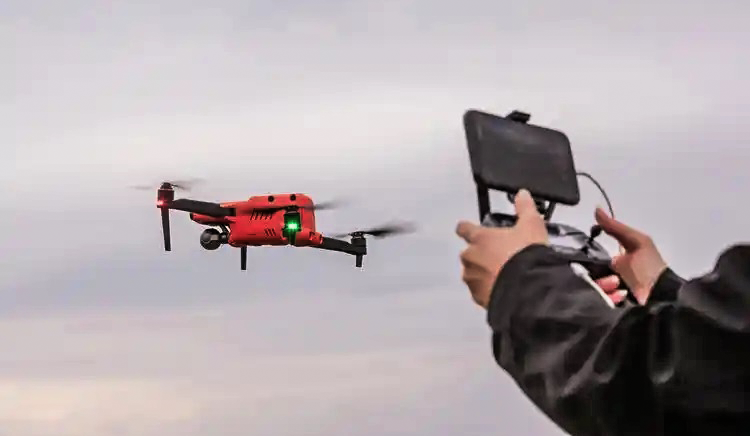
The seamless connection between a drone and its controller is one of the most critical aspects of flight. Whether you are flying a consumer quadcopter for photography or operating an industrial drone for inspection, understanding how this communication works is essential—not only for safe operation but also for grasping how modern drone countermeasures function. In this article, we will explore the communication methods drones use and how counter-drone systems exploit these channels to neutralize threats.
Drone communication consists of two distinct data streams:
Uplink (Control Signal): Transmitted from the controller to the drone. This carries pilot commands such as throttle, yaw, pitch, and roll. It typically operates on lower frequencies like 2.4 GHz to ensure range and reliability.
Downlink (Telemetry and Video): Transmitted from the drone to the controller or ground station. This includes real-time video feed (FPV), battery status, GPS coordinates, altitude, and sensor data. Downlink often utilizes higher frequencies like 5.8 GHz to support the bandwidth required for high-definition video.
Most modern drones use dual-band technology, automatically switching between frequencies to maintain a stable link.
Many entry-level consumer drones use standard Wi-Fi protocols (802.11) to communicate with smartphones or dedicated controllers. While convenient, Wi-Fi is inherently vulnerable to interference and has limited range—typically under 500 meters. From a counter-drone perspective, Wi-Fi-controlled drones are relatively easy to disrupt because they operate on congested, unlicensed spectrum.
Higher-end drones employ Frequency Hopping Spread Spectrum (FHSS) or Direct Sequence Spread Spectrum (DSSS) . These technologies constantly change frequencies or encode signals in a way that makes them resistant to interference and jamming.
FHSS: The system hops across dozens or hundreds of channels per second. This makes it difficult for simple jammers to block the signal, as they would need to cover the entire band simultaneously.
DSSS: The signal is spread across a wide frequency range, allowing the receiver to reconstruct the original data even if parts of the signal are lost.
Manufacturers like DJI, Autel, and Skydio use proprietary digital transmission systems (e.g., DJI OcuSync, Lightbridge). These systems combine FHSS with advanced error correction and adaptive bitrate scaling. They offer low latency, high video quality, and ranges exceeding 10 kilometers in ideal conditions. Because these protocols are proprietary, reverse-engineering them for counter-drone purposes requires sophisticated equipment.
A growing number of enterprise drones incorporate 4G LTE or 5G modules. In this setup, the drone communicates with the controller via cellular networks. This allows for beyond visual line of sight (BVLOS) operations with virtually unlimited range, as long as cellular coverage exists. However, this also introduces new vulnerabilities: counter-drone systems can target the cellular infrastructure rather than the drone’s radio link.
Understanding drone communication is the foundation of counter-unmanned aircraft systems (C-UAS) . Counter-drone devices disrupt the link between the drone and its controller to neutralize potential threats. Here are the most common methods:
Radio frequency jammers transmit high-power noise on the same frequencies that drones use—typically 2.4 GHz and 5.8 GHz. By overwhelming the legitimate control signal, the jammer severs the uplink. Most consumer drones are programmed to respond to signal loss by executing one of three actions:
Return to Home (RTH): The drone automatically flies back to its takeoff point.
Landing: The drone descends immediately.
Hovering: The drone remains in place until the battery depletes.
Because FHSS spreads signals across many channels, jamming modern drones requires wideband jammers capable of covering the entire frequency range simultaneously.
Spoofing is more sophisticated than jamming. Instead of simply blocking the signal, a spoofing device transmits fake GPS coordinates or false control signals to trick the drone. For example, a spoofer can make a drone believe it is outside a no-fly zone or force it to land at a designated location. Spoofing exploits the fact that drones often prioritize GPS data over other inputs.
Some advanced counter-drone systems analyze the communication protocol being used. By reverse-engineering the handshake process or exploiting vulnerabilities in proprietary protocols, these systems can inject commands—such as forcing a drone to land—without triggering the drone’s failsafe modes.
For drones using 4G/5G communication, countermeasures can operate at the network level. Law enforcement or authorized security agencies can coordinate with telecom providers to deactivate the SIM card associated with a suspicious drone, effectively cutting off its command link.
In response to counter-drone threats, manufacturers are building redundant communication links into their drones. A drone might simultaneously use 2.4 GHz for control, 4G as a backup, and even store pre-planned autonomous routes onboard. If one link is jammed, the drone can switch to another or rely on its onboard intelligence to complete the mission safely.
For security professionals, this means that effective counter-drone strategies must go beyond simple jamming. Detecting the drone’s communication method, identifying its failsafe behavior, and deploying layered countermeasures are essential.
| Communication Type | Typical Use | Vulnerability to Countermeasures |
|---|---|---|
| Wi-Fi | Entry-level consumer drones | Easy to jam; limited frequency range |
| FHSS/DSSS | Hobbyist FPV, mid-range drones | Resistant to narrowband jammers; requires wideband jamming |
| Proprietary (OcuSync, etc.) | High-end consumer/enterprise | Difficult to spoof; jamming requires high power |
| 4G/5G Cellular | Enterprise/BVLOS drones | Vulnerable to network-level shutdowns |
Drones communicate with their controllers primarily through 2.4 GHz and 5.8 GHz radio links, utilizing advanced spread-spectrum and proprietary protocols to ensure reliability. However, no communication system is invulnerable. Counter-drone technologies exploit these very communication channels—whether through RF jamming, GPS spoofing, or protocol exploitation—to neutralize unauthorized or hostile drones.
For pilots, understanding how your drone communicates and how it behaves when the signal is lost is crucial for safe and responsible flying. For security professionals, staying ahead requires continuous adaptation to evolving communication technologies.
86-13920737097
AddBuilding 2, Honggao Industrial Park, Bao’an District, Shenzhen, China.
E-mailjackyjingtj@gmail.com
Copyright @ 2026 BNT Jammer
Copyright @ 2026 BNT Jammer
Copyright @ 2026 BNT Jammer